How to Secure Your QuickBooks API Keys in Production Environments

Richard Thornwell
23 June 2026
How to Secure Your QuickBooks API Keys in Production Environments
Exposed API keys are one of the most common — and most devastating — security vulnerabilities in modern software development. When those keys grant access to QuickBooks, the stakes are even higher: we’re talking about payroll data, bank account details, invoices, tax records, and the entire financial backbone of a business. A single leaked key can lead to unauthorized transactions, data breaches, regulatory fines, and irreparable damage to client trust.
In this comprehensive guide, we’ll walk through the security best practices recommended by QuickBooks-Intuit experts and seasoned DevOps engineers for protecting your API keys in production environments. Whether you’re building a SaaS integration, an internal accounting tool, or a custom middleware layer, these strategies will help you lock down your credentials and sleep better at night.
Why QuickBooks API Key Security Matters
Before diving into the how, let’s understand the why. QuickBooks Online (QBO) API keys — including your Client ID, Client Secret, and OAuth 2.0 tokens — serve as the digital keys to your financial kingdom. Here’s what’s at risk if they’re compromised:
- Unauthorized data access: Attackers can read sensitive customer records, invoices, employee payroll data, and bank account information.
- Financial fraud: With write access, a malicious actor could create fraudulent invoices, alter transactions, or redirect payments.
- Compliance violations: Regulations like SOC 2, PCI DSS, and GDPR mandate strict controls over access credentials. A breach can trigger audits, fines, and legal action.
- Reputational damage: Clients and partners lose confidence when financial data is exposed.
- Use `.env` files for local development only — and add `.env` to your `.gitignore` immediately.
- Load environment variables securely in your application:
- Use platform-native environment configuration in production:
- Encrypt at rest and in transit: Ensure your secrets manager encrypts all stored values and uses TLS for all communications.
- Apply the principle of least privilege: Only the specific services and roles that need the QuickBooks keys should have access to them.
- Enable versioning: If a key is rotated or changed, you want a history trail and the ability to roll back.
- Centralize management: Avoid scattering secrets across multiple systems. A single source of truth reduces the attack surface.
- Access Token: Short-lived (typically 1 hour). Used for API calls.
- Refresh Token: Longer-lived (typically 100 days). Used to obtain new access tokens.
- Client ID & Client Secret: Static credentials tied to your Intuit Developer app.
- Store the current access token securely
- Monitor for `401 Unauthorized` responses
- Automatically use the refresh token to obtain a new access token
- Never cache access tokens in client-side code or URLs
- Rotate refresh tokens before they expire (well within the 100-day window)
- Intuit issues a new refresh token each time you use the current one — always store the latest one
- Set up automated alerts for refresh tokens approaching expiration
- Rotate client secrets on a quarterly basis or immediately after any suspected compromise
- In the Intuit Developer Portal, you can generate new credentials and update your secrets manager
- Use a blue-green deployment strategy to rotate without downtime: deploy the new secret, verify functionality, then revoke the old one
- Every API call made with your QuickBooks credentials (timestamp, endpoint, response code, originating IP)
- Secret access events: Who or what accessed the API keys, and when
- Token refresh events: Unusual refresh patterns may indicate token theft
- Failed authentication attempts: Multiple `401` errors could signal a brute-force attack or a compromised key
- Configuration changes: Any modification to secrets, permissions, or integration settings
- Centralize logs using tools like the ELK Stack (Elasticsearch, Logstash, Kibana), Datadog, Splunk, or AWS CloudWatch.
- Create alerts for anomalous patterns:
- Implement real-time dashboards that display:
- Conduct regular access reviews: Quarterly, review who has access to your QuickBooks API credentials and revoke any unnecessary permissions.
- IP allowlisting: If your QuickBooks integration runs from known IP addresses, configure your firewall and Intuit’s app settings to restrict access.
- VPN/Private networking: Route API traffic through a VPN or private network to reduce exposure.
- WAF (Web Application Firewall): Deploy a WAF to filter malicious requests before they reach your integration layer.
- Pre-commit hooks: Use tools like git-secrets, TruffleHog, or detect-secrets to scan for accidentally committed credentials.
Reality check: According to GitGuardian’s 2024 State of Secrets Sprawl report, over 12.8 million new secrets were leaked in public GitHub repositories in a single year. API keys for financial services are among the most targeted.
The bottom line: treating your QuickBooks API keys as first-class secrets isn’t optional — it’s a business imperative.
Section 1: Environment Variable Management — The Foundation
The most fundamental rule of API key security is deceptively simple: never hard-code secrets in your source code. Yet this mistake remains alarmingly common.
The Problem with Hard-Coded Keys
Consider this anti-pattern:
“`python
DO NOT DO THIS
QBCLIENTID = “ABcDeFgHiJkLmNoPqRsTuVwXyZ123456”
QBCLIENTSECRET = “xYz789AbCdEfGhIjKlMnOpQrStUvWx”
“`
If this code is committed to a repository — even a private one — the secret is now stored in version control history forever. Every developer with repo access can see it. If the repo is accidentally made public, the key is instantly exposed to the world.
Best Practices for Environment Variables
.env (local development only)
QBCLIENTID=yourclientidhere QBCLIENTSECRET=yourclientsecrethere QBREDIRECTURI=https://localhost:3000/callback “`clientid = os.environ.get(“QBCLIENTID”)
clientsecret = os.environ.get(“QBCLIENTSECRET”)
if not clientid or not clientsecret:
raise EnvironmentError(“QuickBooks API credentials are not configured.”)
“`
Pro Tip: Never log environment variables during application startup. A common debugging pattern like `console.log(process.env)` can dump your secrets into log files that are stored, shipped, and indexed by log aggregation tools.
Section 2: Secrets Management Tools — Going Beyond Environment Variables
While environment variables are a good starting point, dedicated secrets management tools provide encryption, access control, versioning, and audit capabilities that environment variables alone cannot offer.
Top Secrets Management Solutions
| Tool | Best For | Key Features |
|——|———-|————–|
| HashiCorp Vault | Multi-cloud, enterprise | Dynamic secrets, leasing, revocation, audit logging |
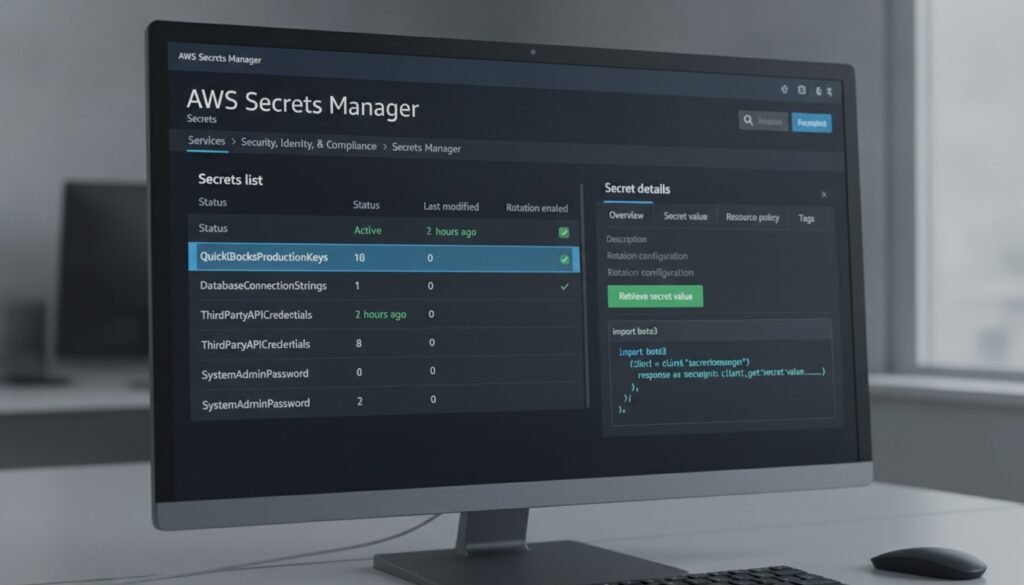
| AWS Secrets Manager | AWS-native workloads | Automatic rotation, RDS integration, fine-grained IAM policies |
| Azure Key Vault | Azure ecosystems | HSM-backed keys, RBAC, certificate management |
| Google Secret Manager | GCP workloads | Versioning, IAM integration, automatic replication |
| Doppler | Developer-friendly, multi-platform | Centralized dashboard, environment syncing, CLI tools |
Implementing HashiCorp Vault for QuickBooks Secrets
Here’s a practical example of storing and retrieving your QuickBooks credentials with Vault:
“`bash
Store the secret
vault kv put secret/quickbooks \
clientid=”ABcDeFgHiJkLmNoPqRsTuVwXyZ123456″ \
clientsecret=”xYz789AbCdEfGhIjKlMnOpQrStUvWx” \
refreshtoken=”yourrefreshtokenhere”
Retrieve the secret in your application
vault kv get -field=clientsecret secret/quickbooks “`In your application code:
“`python
import hvac
client = hvac.Client(url=’https://vault.yourcompany.com:8200′, token=os.environ[‘VAULT
TOKEN’])secret = client.secrets.kv.v2.readsecretversion(path=’quickbooks’)
qbclientid = secret[‘data’][‘data’][‘clientid’]
qbclientsecret = secret[‘data’][‘data’][‘clientsecret’]
“`
Key Principles for Secrets Management
Section 3: Key Rotation Strategies — Limiting the Blast Radius
Even with perfect storage, keys can be compromised through insider threats, social engineering, or zero-day vulnerabilities. Regular key rotation ensures that any compromised credential has a limited lifespan.
Understanding QuickBooks OAuth 2.0 Token Lifecycle
QuickBooks Online uses OAuth 2.0 with the following token types:
Rotation Strategy by Credential Type
1. Access Tokens (Automatic Rotation)
Access tokens expire naturally. Your application should:
“`python
def getvalidaccesstoken():
tokendata = retrievetokenfromsecurestore()
if tokendata[‘expiresat’] <= datetime.utcnow():
newtokens = refreshaccesstoken(tokendata[‘refreshtoken’])
savetokentosecurestore(newtokens)
return newtokens[‘accesstoken’]
return tokendata[‘accesstoken’]
“`
2. Refresh Tokens (Proactive Rotation)
Critical Warning: When rotating secrets, never delete the old secret before confirming the new one works in production. Maintain a brief overlap period to prevent service interruptions.
Automating Rotation with AWS Secrets Manager
“`json
{
“rotationrules”: {
“automaticallyafterdays”: 90
},
“rotationlambdaarn”: “arn:aws:lambda:us-east-1:123456789:function:rotate-quickbooks-secret”
}
“`
Your Lambda function handles the four-step rotation process: createSecret, setSecret, testSecret, and finishSecret.
Section 4: Audit Logging and Monitoring — Detecting Threats Early
Security isn’t just about prevention — it’s about detection and response. Comprehensive audit logging ensures you can identify suspicious activity before it becomes a full-blown breach.
What to Log
Setting Up Effective Monitoring
“`yaml
Example CloudWatch alarm for unusual QuickBooks API activity
AlarmName: QuickBooks-API-Anomaly
MetricName: APICallCount
Namespace: Custom/QuickBooks
Statistic: Sum
Period: 300
EvaluationPeriods: 1
Threshold: 500
ComparisonOperator: GreaterThanThreshold
AlarmActions:
– arn:aws:sns:us-east-1:123456789:security-alerts
“`
Best Practice: Maintain audit logs for a minimum of 12 months to support compliance requirements and forensic investigations.
Section 5: Additional Hardening Measures
Beyond the core strategies above, consider these additional layers of defense: